
TE Event Interpretation home

Simultaneous interpretation

Simultaneous interpretation services for conferences, summits, and meetings

Your speakers present at their normal pace. Interpreters in soundproof booths render every word in real time, and each attendee chooses a language on a receiver. We supply the interpreters, the booths, the system, and the technicians who run it.

  1. Floor audioThe speaker’s microphone feeds the sound system and the booths
  2. The boothTwo interpreters per language, swapping every 15 to 20 minutes
  3. The transmitterEach language on its own channel, by infrared or radio
  4. The receiverEach attendee picks a channel and listens on a headset

A closed audio loop. Our technicians test the whole chain before your first session.

  • Two interpreters per language, per room
  • Our own booths, transmitters, and receivers
  • Technicians on site for the whole program
  • ISO 9001 & ISO 18841 certified · GSA contract holder · HUBZone small business · SBA 8(a) graduate

The short answer

What is simultaneous interpretation?

Simultaneous interpretation is real-time interpretation. Interpreters sit in soundproof booths, listen to the speaker through headsets, and speak the message into a microphone in another language, only a few seconds behind the speaker. Attendees hear it on a receiver and headset and choose the language they want.

  • PaceNo stoppingSpeakers present at their normal pace, so the program stays on schedule.
  • LanguagesSeveral at onceEach language travels on its own channel, alongside the original.
  • SystemBooth to receiverBooths, consoles, a transmitter, and a receiver for each listener.
  • Best forConferences and summitsPlenaries, panels, forums, and any room with listeners in different languages.

Simultaneous or consecutive interpretation?

Both are professional interpreting. They differ in pace, equipment, and the kind of event they suit. If your room is large, your agenda is full, or you need several languages at once, simultaneous is usually the answer.

Choose simultaneous when

  • The program has a full agenda and must keep its schedule.
  • Attendees need several languages at once.
  • You are running a conference, plenary, panel, or summit.
  • Listeners need to react, ask questions, and vote in real time.

Choose consecutive when

  • The setting is small or interactive, such as short remarks, site visits, or a small meeting.
  • The speaker can pause every few sentences while the interpreter repeats the message.
  • You do not need a booth, but can accept roughly double the speaking time.

Compare all interpretation options Remote and hybrid interpretation

Live events

Live event interpretation: human interpreters, remote interpreters, or AI captions?

At a live event, such as a conference, summit, product launch, or town hall, attendees need the program in their language as it happens. There are three ways to deliver it, and each suits a different kind of event.

Interpreters in booths, on site

Simultaneous interpreters work from soundproof booths in the room, and attendees listen on receivers. This is the right choice for formal conferences, summits, multi-day programs, and any session where accuracy and nuance matter: negotiations, technical, legal, and medical content. We plan two interpreters per language per room.

Remote and hybrid interpreters

Professional interpreters work from a remote location through an interpretation platform. Online attendees choose their language in Zoom, Microsoft Teams, Webex, or a dedicated platform, and in-room attendees can listen on receivers. It suits virtual and hybrid events. Remote and hybrid interpretation.

AI captions and machine interpretation

Software produces captions or a synthetic voice in real time. It can help with informal, low-stakes sessions or as an extra access option, but it struggles with accents, specialized terms, names, and crosstalk, and no one corrects errors live. We offer AI captions and AI interpretation as an option alongside human interpreters, for example to add languages to a low-stakes session. See human vs. AI interpretation. For Deaf and hard-of-hearing attendees we provide ASL interpreters and CART captioning by human professionals.

Not sure which fits? Send us the format, languages, and audience, and we will recommend a setup. Planning from scratch? Read how to plan interpretation for a conference.

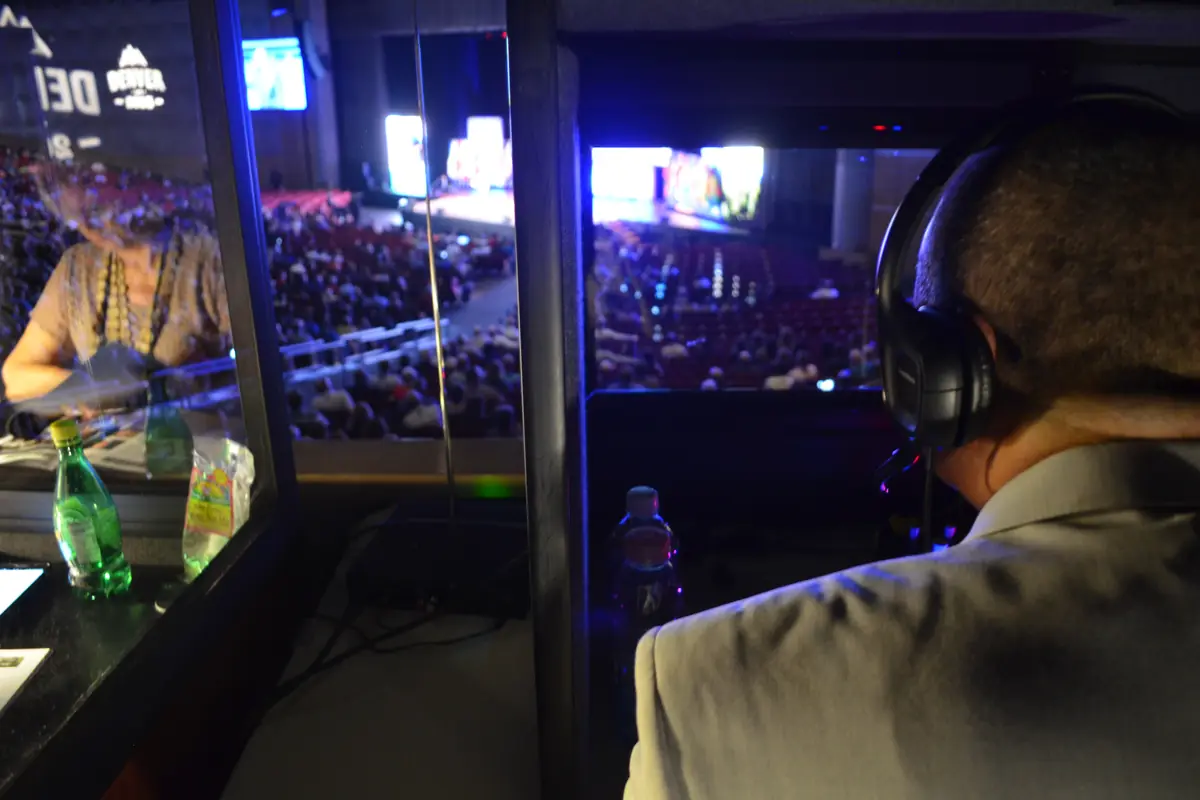
An interpreter in a booth at the back of a large arena, wearing a headset, with the stage and screens in view.

What is included

Two interpreters per language, working in shifts

Simultaneous interpreting means listening, understanding, and speaking at the same time, which is among the most demanding forms of language work. Most professional interpreters can work at full accuracy for 15 to 20 minutes before they need to hand off.

So we staff a team of two per language, per room. While one interprets, the partner tracks names, numbers, and terminology and takes over at a natural break. Long days and very technical sessions can call for a third interpreter. The result your audience hears is consistent from the opening keynote to the closing remarks.

How we select and brief conference interpreters

Everything a simultaneous program needs, from one team

When interpreters come from one vendor and equipment from another, a problem in the middle of a session has no clear owner. We provide both, under one project manager and one contract.

Interpreter teams

Conference interpreters for your language combinations and subject matter, briefed on your agenda, speakers, and terminology.

Booths

Full-size soundproof booths for conference halls and table-top booths for smaller rooms, each with interpreter consoles and headsets.

Transmission

Bosch Integrus infrared systems for confidential, interference-free rooms, and FM and digital systems from Williams AV where they fit better.

Receivers and headsets

Enough receivers for your audience plus spares, charged and tested, with hygienic ear pads.

Microphones and AV

Speaker and delegate microphones and, when you need them, sound systems, projectors, screens, and cameras for recording or streaming.

Technicians and a project manager

Our technicians install, test, and run the system for the whole program. Your project manager coordinates the interpreters, the venue, and your team.

Setups

The right setup for your room

We recommend the booth, the transmission, and the format for each room, not one setup for every event.

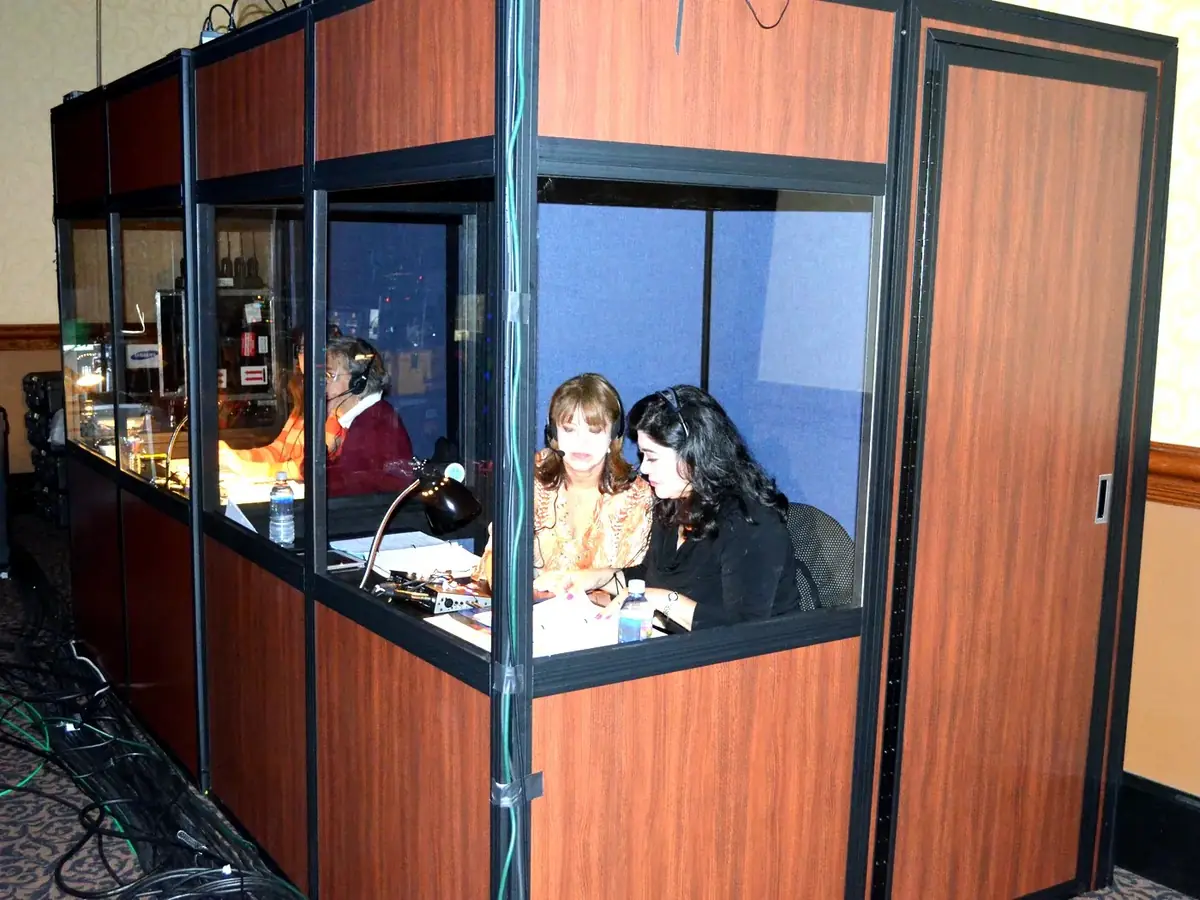
Two interpreters working in a full-size soundproof booth in a hotel ballroom, with more booths in a row beside it.

Full-size and table-top booths

Full-size booths suit conference halls and need floor space, power, and build time; large setups can need loading-dock access. Table-top booths suit smaller rooms. Interpreters need to see the speaker and the slides, so we plan placement with your venue.
Equipment rental with technicians

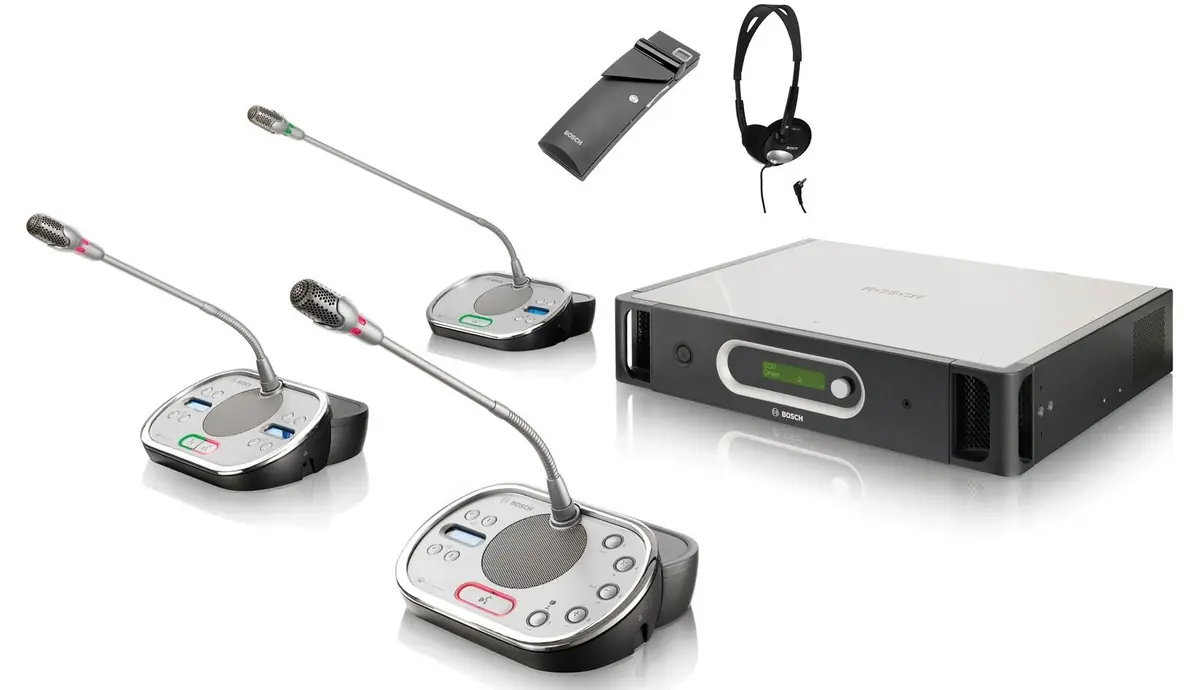
A Bosch Integrus interpretation system: delegate microphone units, a transmitter, a body-pack receiver, and a headset.

Infrared or radio transmission

Infrared stays inside the room, so it is private and free of radio interference, which suits confidential meetings and venues with many wireless systems. FM and digital radio systems are portable and travel well between rooms or outdoors.

What an interpretation system includes

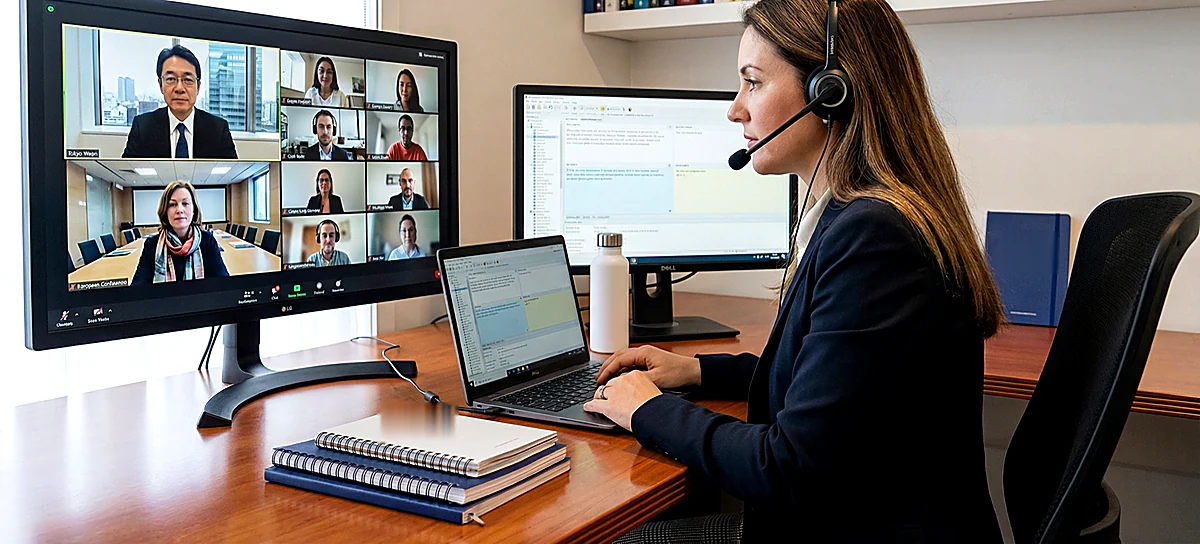
An interpreter wearing a headset in front of a monitor showing a video meeting.

In the room, remote, or hybrid

Interpreters can work from booths in the room or remotely, and we route the interpreted audio to receivers in the venue and to your stream or meeting platform for online attendees.

Remote and hybrid interpretation

Team size

How many interpreters and booths will you need?

The planning rule is simple: two interpreters per language, per room, and one booth for each of those teams. Set your languages, rooms, and audience to see the setup.

Not counting the language spoken from the stage.

Example: 2 languages in 3 rooms with 500 attendees.

12interpreters
6booths
500+receivers, plus spares
Room 1
Room 2
Room 3

A planning guide, not a quote. Long days or very technical content can call for a third interpreter, and the venue decides what fits. We confirm team size and equipment in your quote.

Get this scoped into a quote

Receivers are planned for every attendee who will listen in a language other than the floor language, plus spares. If you do not know that number yet, registration data or one question on your registration form usually answers it.

A real program: the Cities Summit of the Americas in Denver used 32 interpreters, 16 booths, and more than 2,000 receivers for over 3,000 attendees. Read the case study.

Planning notes

Five things to settle early

These decisions shape the setup and the quote. We work through each one with you.

How far ahead should you book? As early as your dates are firm. More lead time gives us a wider choice of interpreters for your subject, and for equipment rental we recommend at least two weeks. If your event is sooner, call us: because we own our equipment, short-notice requests are often still possible.
  1. Languages and directions

    Which languages attendees will listen in, and whether any speakers will present in a language other than the floor language. Each listening language needs its own booth and team.

  2. Rooms running at the same time

    Every room with interpretation needs its own booths, interpreters, transmitter, and receivers. Concurrent breakouts multiply the setup, so the session grid matters early.

  3. Booth space and sightlines

    Interpreters need to see the speaker and the slides. A full-size booth needs floor space at the back or side of the room, power, and time to build; large setups may need loading-dock access.

  4. Receiver distribution

    Who hands out receivers, where, and how they come back. We plan the desk with your registration team and supply spares.

  5. Materials for the interpreters

    Agenda, slides, speeches, speaker names, and acronyms, as early as possible. Preparation is the single biggest factor in interpretation quality that you control.

The process

From first call to final session

Tune to a step to see what we do and what we need from you.

01

Scope the event

What we doWe learn your dates, venue, languages, audience, and agenda, and recommend a setup.
What we need from youShare your dates, venue, languages, audience, and agenda.
02

Quote and confirm

What we doYou receive a quote covering interpreters, equipment, technicians, and any remote platform.
What we need from youReview the quote and confirm.
03

Staff and prepare

What we doWe select and brief interpreters, collect your materials, and plan the venue setup.
What we need from youSend your agenda, slides, speaker names, and acronyms.
04

Set up and test

What we doTechnicians install and test every channel and receiver before attendees arrive.
What we need from youGive us venue access and load-in details.
05

Deliver and support

What we doYour project manager and technicians stay with the program until the last session ends.
What we need from youRun your event. We run the interpretation.

Request an event quote See the full planning and delivery process

Proof

Simultaneous programs we have delivered

Colorado Convention Center, Denver, April 2023

Cities Summit of the Americas

Simultaneous interpretation in English, Spanish, and Portuguese, with booths, receivers, and technicians, for the inaugural summit led by the U.S. Department of State.

attendees
3,000+
interpreters
32
full-size booths
16
receivers
2,000+

Read the case study: Cities Summit of the Americas

World Credit Union Conference, Boston, 2024

World Council of Credit Unions

Simultaneous interpreters and the full interpretation equipment, engaged directly by WOCCU.

attendees
2,400
languages
6
interpreters
14

Winter Weekend, Vail, Colorado

The Carter Center

Mandarin simultaneous interpretation and equipment, including interpreting for President and Mrs. Carter in U.S.–China relations meetings.

participants
300
languages
2
breakout sessions
4

I’d like to express my sincere appreciation for your team’s outstanding service in accommodating our request within a tight timeframe. Your on-site team was professional and provided exactly what we needed.

Patrick JonesDivision Manager, U.S. Department of EducationInternational Summit on the Teaching Profession: 9 languages, 350+ delegates

The Translation Excellence team provided support services to the 14th U.S.–China Oil and Gas Industry Forum and proved to be reliable, flexible and crucial to the success of the event.

Andrew PalmateerActing Deputy Director, U.S.–East Africa Geothermal Partnership, United States Energy Association14th U.S.–China Oil and Gas Industry Forum, Denver: equipment and technician for 200 participants

See more projects and client feedback

Cost and quotes

What shapes the price, and what we need to quote it

We price interpreters, equipment, and technical support in one quote, so you can compare the full cost. These are the main drivers:

  • The number of languages and the length of each day
  • The number of rooms running at the same time
  • The size of the audience, which sets the receivers
  • The venue setup and logistics, including load-in
  • Interpreter and crew travel

Send what you know

You do not need every answer to start. We fill the gaps with you on a short call.

  • Dates and hours, including setup and evening sessions
  • City and venue, or the meeting platform
  • Languages, and in which directions
  • How many attendees will need a receiver
  • Plenary only, or breakouts in parallel
  • The agenda and anything technical or sensitive
  • Who is producing sound, video, and streaming

Prefer to talk? Call 720-325-0459.

Questions

Simultaneous interpretation questions

What is simultaneous interpretation?

Simultaneous interpretation is real-time interpretation. Interpreters work from soundproof booths, listen to the speaker through headsets, and speak the message into a microphone in another language a few seconds behind the speaker. Attendees listen on receivers and choose their language, so the speaker never has to pause.

How much does simultaneous interpretation cost?

Cost depends on the number of languages, the length of each day, the number of rooms running at once, the size of the audience, the venue setup, and any interpreter or crew travel. We price interpreters, equipment, and technical support in one quote, so you can compare the full cost. Send your event details for a scoped quote.

What happens if an interpreter is sick or equipment fails?

We plan every event with backup interpreters and spare equipment, and our technicians stay for every session, so the program keeps running. How we plan for what can go wrong.

How many interpreters will my event need?

Plan on a team of two interpreters per language, per room. Simultaneous interpreting is demanding work, and partners hand off every 15 to 20 minutes so quality holds all day. Long days or very technical content can call for a third interpreter. We confirm team size in your quote.

What is the difference between simultaneous and consecutive interpretation?

In simultaneous interpretation, interpreters work from a booth and speak at the same time as the presenter, which keeps the program on schedule and suits conferences, plenaries, and panels. In consecutive interpretation, the speaker pauses every few sentences and the interpreter repeats the message. It needs no booth but roughly doubles speaking time, so it suits short remarks, site visits, and small meetings. Compare all options.

Infrared or radio: which system is better?

Infrared stays inside the room, so it is private and free of radio interference, which suits confidential meetings and venues with many wireless systems. FM and digital radio systems are portable and travel well between rooms or outdoors. We recommend the system for each room.

How many receivers should we order?

Plan for every attendee who will listen to a language other than the floor language, plus spares. If you are not sure how many attendees will need interpretation, registration data or a question on your registration form usually answers it.

How long does setup take?

It depends on the number of booths and rooms. Table-top booths and portable systems set up quickly; full-size booths and multi-room systems take longer and are usually installed before the event day. We schedule setup and testing with your venue.

Can attendees use their own phones instead of receivers?

For some events, yes. Dedicated interpretation platforms can stream each language to a listener app on attendees’ phones. Venue Wi-Fi and attendee headphones become part of the plan, so we discuss the trade-offs with you before recommending it.

Do you provide only equipment, if we already have interpreters?

Yes. We rent booths, consoles, transmitters, receivers, and headsets with technicians to run them, including to interpretation agencies supplying their own interpreters. Equipment rental.

Can you support hybrid events with in-person and online attendees?

Yes. Interpreters can work from booths in the room or remotely, and we route the interpreted audio to receivers in the venue and to your stream or meeting platform for online attendees. Remote and hybrid interpretation.

How far ahead should we book?

As early as your dates are firm. More lead time gives us a wider choice of interpreters for your subject, and for equipment rental we recommend booking at least two weeks before the event. If your event is sooner, call us: because we own our equipment, short-notice requests are often still possible.

Our headquarters is in the Denver metro area and we have an office in Washington, D.C.; our crews and equipment travel to venues nationwide. See Denver, Washington, D.C., and all the cities we serve.

Next step

Plan your simultaneous interpretation

Share the date, location, languages, and expected audience. We will come back with a plan for interpreters, equipment, and on-site support, and a quote you can take to your budget holder.

Reviewed by · Updated